What Is an Automatic Newspaper Generator? (Complete 2026 Guide)
An automatic newspaper generator picks stories, writes them in your language, and lays out pages in minutes. Here's how the technology works and why Indian publishers are adopting it.
"Automatic newspaper generator" is a category of software that produces a complete, print-ready newspaper edition with minimal human intervention. You provide a template and editorial preferences; the software does the rest — pulling stories, writing them in your language, fitting them in columns, and exporting PDFs. This guide explains how the technology works.
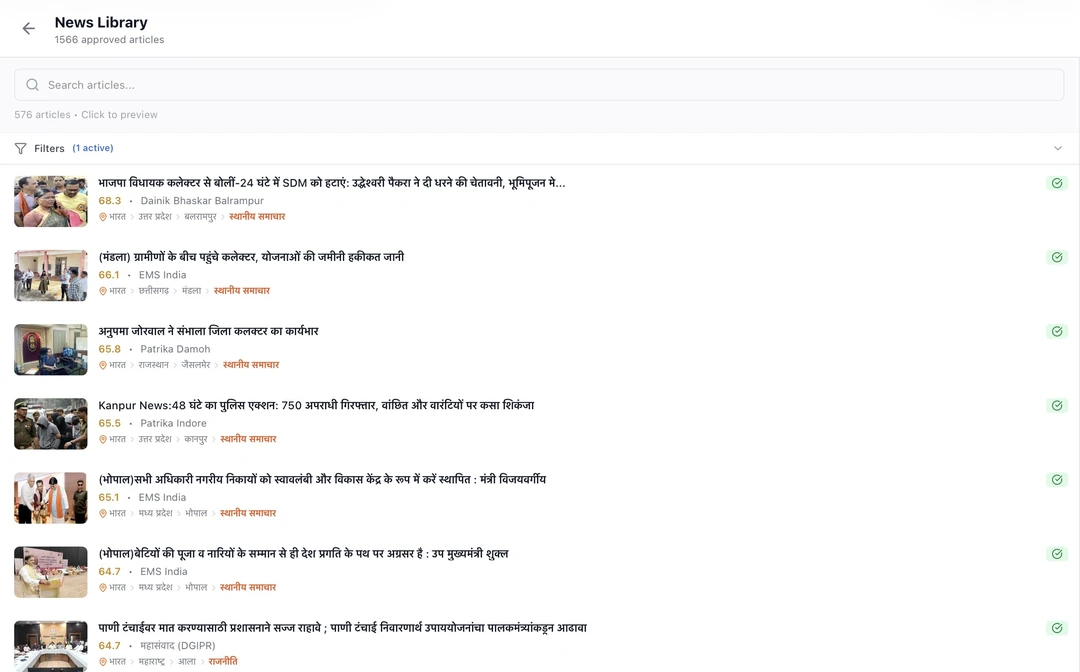
The four stages of automatic generation
1. News aggregation
The software scrapes articles from RSS feeds, wire services (PTI, ANI, Reuters), government press releases, and regional sources. For Indian publishers, this typically means 50–100 Hindi sources covering state, city, and district news — updated every hour.
2. Article scoring and deduplication
A scoring model ranks each article by relevance to your city, freshness, richness of information, and whether the same story appeared in multiple sources (usually means it's important). Duplicates get merged. Results: a shortlist of 200 candidates ranked by "how much does my reader care?"
3. Content rewriting
An AI language model (GPT-4o-mini in XLR8 Print's case) translates English wire copy into Hindi, rewrites in the style of a newspaper headline + lede + body, and regenerates content to fit frame dimensions exactly. Critically: it never truncates. If content doesn't fit, it regenerates shorter. This is the difference between a professional newspaper and a rough auto-translation.
4. Layout + export
A template engine places the generated content into pre-designed page frames, handles photo selection from the newsroom library, formats the imprint line per RNI rules, and exports a 300 DPI print-ready PDF. Total time: under 10 minutes for a 4-page edition.
What automatic generators don't do
- Original reporting. They aggregate existing news. Your reporters still do the boots-on-ground work.
- Editorial judgment on sensitive stories. Local politics, communal matters, legal cases — a human editor must sign off.
- Advertising sales. You still sell ads; the software just places them.
- Distribution. Getting the paper to doorsteps is still your network.
Who benefits most
- District dailies with 2–8 page editions
- Weekly tabloids with limited in-house production
- New newspaper launches testing market fit
- Chains with 3–15 editions wanting consistent quality across cities
Who doesn't need one
- Investigative magazines (long-form, bespoke layout)
- National dailies with in-house design teams of 20+
- Art publications, poetry, fiction (need manual craft)
The transformation
For a typical district daily, automatic generation cuts production time from 8 hours to 15 minutes and move production away from one-person dependency. That's not the point though — the point is that the publisher now sleeps through the night knowing tomorrow's paper will be on time.
Start XLR8 Print onboarding and evaluate automatic newspaper generation.
Related Articles
Hiring a DTP Operator vs Automated Newspaper Software: Real Cost Breakdown
A practical comparison of DTP operator dependency vs automated newspaper software, including leave days, training time, and late-night production risk.
Software ReviewsBest Hindi Newspaper Design Software in 2026: Buyer's Guide
A 2026 comparison of the seven tools Indian Hindi publishers actually use — Adobe InDesign, QuarkXPress, Scribus, 4C Plus, Canva, Affinity Publisher, and XLR8 Print.