Canva vs XLR8 Print for Hindi Newspaper Design: The Honest Comparison
Canva is great for social posts — not for 12-page Hindi newspapers. Here's what breaks, what works, and why publishers switch to XLR8 Print.
"Can I just use Canva for my Hindi newspaper?" It's the most common question we get from publishers evaluating their options. The honest answer: Canva is a brilliant tool, but not for a 12-page Hindi newspaper. Here's the technical and practical breakdown of why, and what actually works.
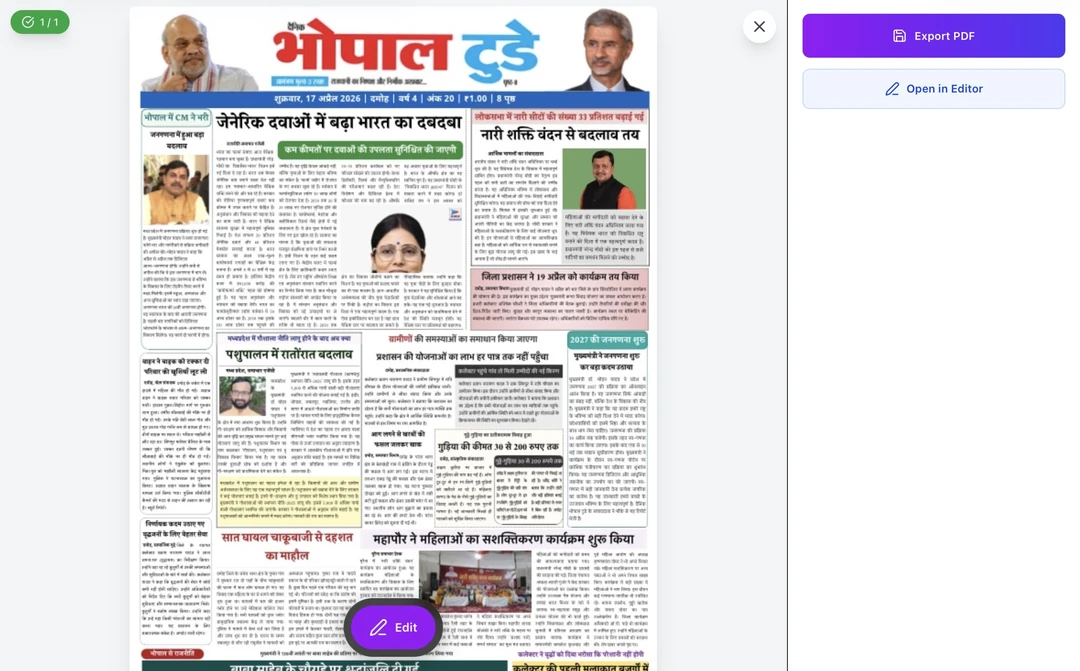
What Canva does well
Canva is unbeatable for Instagram posts, flyers, posters, presentations, and one-off brochures. For those use cases it is the best tool in the world. The template library is massive, the drag-and-drop UX is forgiving, and the free tier is generous.
Where Canva falls apart for Hindi newspapers
1. Devanagari typography breaks visibly
Canva's text engine was built for Latin scripts. Devanagari has features Latin doesn't — the shirorekha (the continuous horizontal line at the top of every word), matras that stack above and below, and hundreds of conjunct ligatures. When you apply letter-spacing, justification, or certain font weights in Canva, the shirorekha breaks into fragments, matras drift off their consonants, and conjunct characters fall apart. On a social post you might not notice. On a printed newspaper with 3-point body copy, it's immediately ugly.
2. No frame linking for text flow
Real newspapers have stories that flow across columns and pages — "continued on page 3". Canva has no concept of linked text frames. You copy-paste each column manually. A 12-page edition becomes hours of reflow work every time a headline changes.
3. No master pages, no automatic page numbering
Canva's "Brand Kit" is not a master page system. Newspaper layouts need a repeating masthead, folio, imprint line, and page numbers that auto-update across pages. In Canva you maintain each page as a separate design and hope you remembered to update all 12.
4. PDF export is not print-ready
Canva exports at 96 DPI by default. You can pay for 300 DPI in Canva Pro, but there's no CMYK colour support, no bleed/trim marks, no PDF/X-1a, and no control over image compression. Your printer will not thank you.
5. No RNI compliance helpers
Indian newspapers need an imprint line with RNI number, publisher name, printer name, place of publication, and printing press address — formatted exactly per RNI guidelines. Canva has no template for this. You type it yourself each edition and hope the RNI inspector never notices an inconsistency.
The practical comparison table
| Feature | Canva Pro | XLR8 Print |
|---|---|---|
| Shirorekha-safe Hindi | No | Yes, 10 calibrated fonts |
| Linked text frames | No | Yes |
| Master pages | No | Yes |
| 300 DPI print-ready PDF | Pro only, no CMYK | Built-in |
| RNI imprint template | No | Auto-generated |
| AI auto-fill from news sources | No | Yes, 100+ sources |
When Canva is still the right call
If you produce a 1-page weekly with 200 words of Hindi content, Canva works. If you're a student magazine or a hyperlocal bulletin with minimal typography, Canva works. The moment you need multi-page production, automated layout, proper Devanagari, or print-ready output, Canva is the wrong tool.
The bottom line
Canva and XLR8 Print are not competitors. They solve different problems. Canva is a social media design tool. XLR8 Print is a newspaper production system. If you're running a real Hindi newspaper — even a 2-page district daily — you need the second, not the first.
Try XLR8 Print through the onboarding flow and see the difference for yourself. Start onboarding.
Related Articles
XLR8 Print vs Adobe InDesign: Why Indian Newspapers Are Switching
Complete workflow and feature comparison showing why XLR8 Print works better for Hindi newspapers that want operator-independent production.
Software ReviewsScribus vs XLR8 Print for Hindi Newspapers: Honest Comparison
Scribus is free and used by Dainik Jagran. XLR8 Print is managed, Hindi-first, and built for production speed. Here's when each makes sense — including the IT support overhead nobody talks about.